Pragmata's Forgiving Learning Curve: PC Demo Gameplay Impressions
Anticipation for Capcom's enigmatic action game, Pragmata, has been building for years. With its ethereal atmosphere and intriguing premise, players have eagerly awaited a chance to dive into its unique world. To both stoke the flames of excitement for its 2026 launch and gather valuable feedback across diverse hardware setups, Capcom recently shadow-dropped the "Sketchbook Demo" for PC. This totally free, roughly 20-minute experience offers a crucial first look at the core Pragmata gameplay loop, revealing a surprisingly forgiving learning curve despite its innovative blend of combat and puzzle-solving mechanics. Our impressions from the PC demo highlight how Hugh, the seasoned spacefarer, and Diana, the enigmatic young girl with extraordinary hacking abilities, intertwine to create a truly distinct interactive experience.
The Dynamic Duo: Hugh, Diana, and the Core Loop of Pragmata Gameplay
The heart of Pragmata lies in the symbiotic relationship between its two protagonists. Hugh and Diana are inseparable, not just narratively, but in every aspect of the gameplay. The demo wastes no time in illustrating this fundamental synergy, where Diana's hacking skills aren't just an optional utility but the absolute linchpin for both progression and survival. Whether faced with an environmental puzzle blocking their path or a formidable foe, Diana's digital prowess is the "opening act" that enables Hugh to effectively navigate and overcome obstacles.
This division of labor immediately establishes a clear understanding of each character's role, contributing significantly to the demo's accessible nature. Players quickly grasp that Diana softens targets, opens pathways, and creates opportunities, while Hugh follows up with the necessary force. This seamless hand-off ensures that even complex scenarios feel manageable, allowing players to focus on mastering each character's distinct contribution to the overall Pragmata gameplay.
Puzzle Solving: Diana's Digital Key to Progression
One of the earliest and most straightforward applications of Diana's hacking is found in environmental puzzle-solving. When confronted with seemingly impassable barriers like locked doors or inactive lifts, Diana's unique abilities come into play. These hacks manifest as intuitive mini-games, designed to be easily understood and executed, further reinforcing the forgiving learning curve. For instance, activating an elevator might require players to precisely align a series of four icons into a central target zone within a given timeframe. The simplicity of these prompts means players can quickly grasp the mechanics without getting bogged down in intricate tutorials, allowing them to maintain immersion in Pragmata's captivating world.
These initial puzzle encounters serve as an excellent primer, familiarizing players with the concept of "hacking mode" before introducing its more intense combat applications. They build confidence and understanding, ensuring that by the time Hugh and Diana encounter their first enemies, players are already comfortable with the basic interaction model.
Combat Hacking: Opening the Door to Damage and Strategy
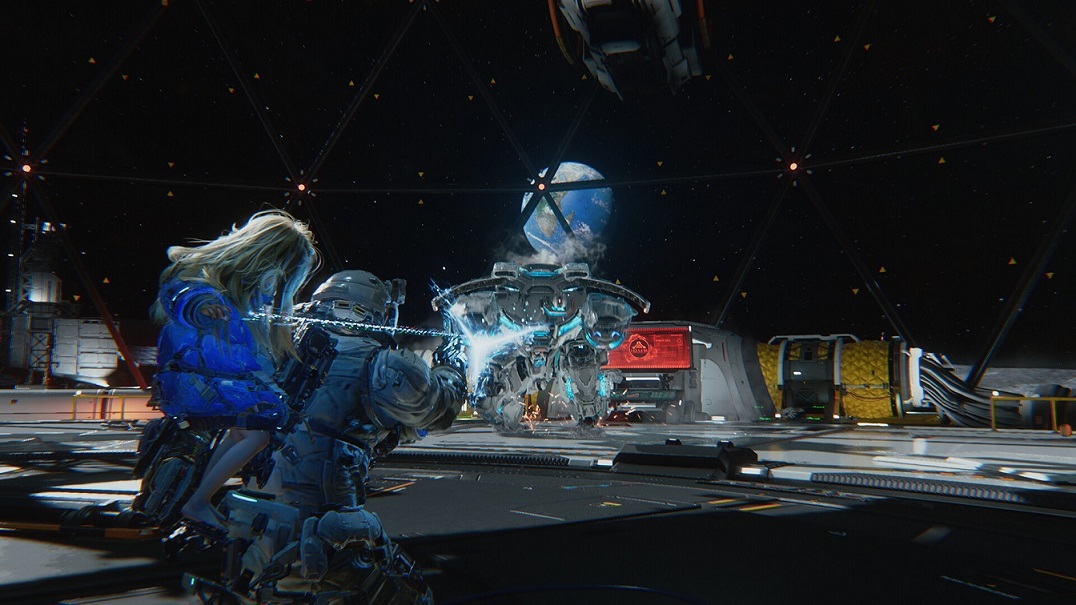
Where Diana's hacking truly shines and differentiates Pragmata from other action titles is in its combat system. Hugh's conventional weapons, like his default Grip Gun, are largely ineffective against unhacked enemies. This makes Diana's intervention not just helpful, but essential for dealing meaningful damage. The transition into combat hacking is fluid: after aiming as you normally would in a third-person shooter, holding or pressing a dedicated hacking button (which is fully remappable in settings) activates "hacking mode."
Upon activation, a small grid appears on your HUD, and your aiming controls dynamically shift to hacking controls. Your objective is to draw a path from a starting point to an exit node within a specified time limit. Along this path, you'll encounter colored nodes that trigger various effects upon passage. This minigame requires quick thinking and precision, but its clear visual cues and objective keep it from feeling overwhelming.
Adding another layer of strategic depth are special hacking nodes scattered throughout your journey. These nodes, though limited in uses, provide substantial buffs to Diana's abilities. In the demo, two key special hacks are introduced:
- Multihack: Enables Diana to hack multiple enemies simultaneously, invaluable when dealing with groups.
- Decode: Significantly increases the damage taken by hacked targets, perfect for focusing down tougher foes or boss-like enemies.
A crucial balancing act is that only one type of special node can be held at a time, forcing players to make tactical decisions based on the current combat situation. Should you need to disengage from hacking mode, a second press or release of the hacking button (depending on your chosen settings) allows for a quick exit, enabling Hugh to capitalize on Diana's efforts or reposition. Often, multiple hacks may be required to fully neutralize a threat, either due to enemy health or the expiration of a previous hack's duration. For a deeper dive into how these combat mechanics intertwine, be sure to read our dedicated piece on Pragmata Demo: Mastering Diana's Hacking & Combat Synergy.
Hugh's Offensive Arsenal and the Overdrive Protocol
Once Diana successfully hacks an enemy, the true catharsis of Pragmata gameplay comes to the fore as Hugh unleashes his firepower. His weapons, particularly the default Grip Gun, possess respectable damage and high stopping power, making short work of vulnerable, hacked targets. While the demo only gives a glimpse, it hints at a wider array of powerful weapons Hugh will be able to acquire in the full game, allowing players to tailor their combat approach.
Beyond standard weaponry, the demo introduces the Overdrive Protocol, a powerful ultimate attack. As Diana continuously hacks targets, she builds up charge for this devastating ability. Once activated, the Overdrive Protocol deals substantial damage, stuns enemies, and crucially, leaves them wide open for Hugh's follow-up attacks. While this mechanic only makes a brief appearance towards the end of the demo, its strategic potential is immediately apparent. Players will want to keep the Overdrive Protocol in mind for the full release, as mastering its timing and deployment could be key to overcoming some of Pragmata's toughest challenges.
Why Pragmata's Learning Curve Feels Forgiving
The "forgiving learning curve" mentioned in initial impressions isn't just a happy accident; it's a deliberate design choice that makes Pragmata's complex systems surprisingly approachable. Here's why:
- Clear Role Definition: The distinct roles of Diana (enabler/hacker) and Hugh (damage dealer/explorer) are immediately clear, reducing cognitive load.
- Intuitive Mini-Games: Both puzzle and combat hacking use simple, visually guided mini-games that are easy to understand and react to, even under pressure.
- Gradual Introduction: Core mechanics are introduced one by one. Environmental puzzles ease players into hacking before the more demanding combat scenarios. The Overdrive Protocol, a more advanced mechanic, is saved for the demo's conclusion, hinting at future depth without overwhelming early on.
- Player Customization: The ability to remap controls and choose between press/hold options for hacking mode termination allows players to fine-tune the experience to their comfort.
- Clear Feedback: The immediate impact of Diana's hacks on enemies (stuns, damage buffs) provides clear, positive reinforcement, encouraging players to master the system.
This thoughtful design ensures that players can quickly grasp the fundamentals and begin enjoying the unique flow of Pragmata gameplay without feeling frustrated by its inherent complexity. It perfectly balances innovation with accessibility, setting a strong foundation for the full game.
Conclusion
The PC "Sketchbook Demo" for Pragmata offers a compelling glimpse into Capcom's ambitious new IP. It effectively showcases the innovative synergy between Diana's hacking and Hugh's combat prowess, establishing a core gameplay loop that is both unique and deeply satisfying. Crucially, the demo succeeds in presenting these multifaceted mechanics within a surprisingly forgiving learning curve, inviting players to experiment and grow rather than intimidating them with complexity. This accessibility, combined with the intriguing premise and stunning visuals, leaves us eagerly anticipating the 2026 launch. If you haven't yet, we highly recommend trying out the free demo to experience this refreshing blend of action and strategy for yourself. Players eager to see more of this groundbreaking gameplay can also check out impressions from other platforms, such as Pragmata on Switch 2: Dive Into 18 Minutes of Demo Gameplay.